Beef Cuts from the Beef Primal Chuck | ||
Beef Chuck Blade Roast This large roast contains many small muscles and is easily identified by the blade bone located in the upper center of this cut. Note also that rib bones and a portion of the backbone are located along the lower left portion of the cut. However, these bones may be removed from this large roast before it is packaged and put in the meat counter at the local supermarket. Cooking Recommendations Beef Chuck Blade Steak The Beef Chuck Blade Steak is similar to the beef chuck blade roast. It is usually cut less than one inch thick. The blade bone shown in this slide has the typical shape of the "sevenbone", a term frequently used in the meat trade. [Flat iron: Also called Boneless Top Blade, it's cut from the chuck and sold as steaks. It's remarkably tender and full-flavored. This shoulder top blade steak is cut in a way that eliminates the connective tissue that runs through the center. Each half resembles a flank steak in shape. These pieces are cut crosswise into individual steaks. Cooking Recommendations Beef Chuck Arm Roast The Beef Chuck Arm Roast is identified by its thickness as a roast, the large round bone in the center of the cut and the many small muscles of which it is made. This roast may or may not have a cross cut rib bones showing but if present would be at the bottom of the picture. Cooking Recommendations Braise, Grill, Panbroil, Panfry, or Broil
| 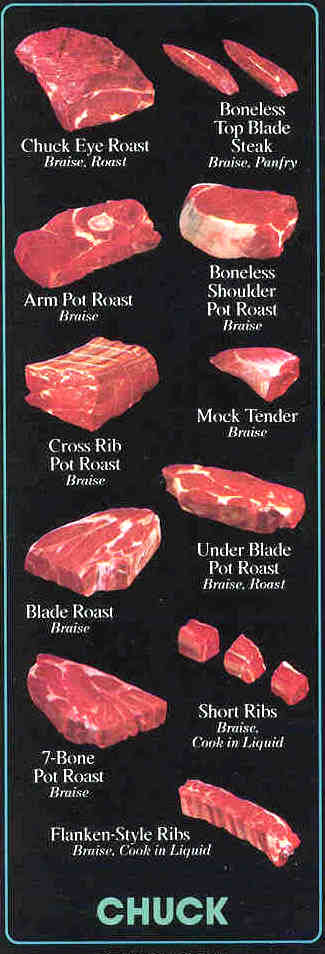 | |
Short Ribs & Flanken-Style Ribs Short Ribs are small cubes containing a section of the rib bone and thin layers of muscles. The muscles of the chest perform considerable work and are therefore not very tender.Cooking Recommendations Braise, or Cook in Liquid or BBQ | ||
Just Click on the links below to see a photograph of that cut, its description and nutritional data!
| ||
| Braising is a technique done by browning the meat on all sides in a heavy utensil. A small amount of water is added and then the meat is cooked until tender at a low temperature. Braising means to brown meat in a small amount of oil in a heavy pan or Dutch oven which has a tight fitting oven proof lid. You then add a small amount of liquid, -about a cup, cover tightly, and simmer on the stove top or in the oven until done. You can vary the cooking liquid, add seasonings to it, and add vegetables. You can achieve wonderful results from more modestly priced cuts of meat. | ||
| Cooking in Liquid is often used to prepare less tender cuts of meat. The meat is covered in liquid, (usually water) and is simmered until tender. The process may require several hours because of the lower temperatures. This is the same as braising except you add sufficient cooking liquids to cover the meat completely. You cover the pan tightly after you have browned the meat and added the cooking liquid, and simmer on the top of the stove or in the oven. Cooking with moist heat is very forgiving. Stews, pot roasts, etc. are very easy to do, even for the beginning cook. | ||
Grilling is a variation of broiling, which is usually done on a grill with charcoal or gas flames. Charcoal briquettes are commonly used for grilling. When starting charcoal, highly flammable materials are used often used that cause large amounts of open flames. These flames should be allowed to burn off and the charcoal should become a gray color. Although they require a longer preparation time than gas they burn very hot and consistently for a long period of time. When the charcoal becomes gray and the heat is even throughout the grill. The meat is placed on the grill and is browned on side, seasoned, and then the other side is grilled to the desired doneness. The flames from the charcoal or gas should never be aloud to come in contact with the meat. Frame-ups should be avoided by sprinkling with a small amount of water. Grilling is a method of cooking beef over open flame or an intense heat source. Often meat is rubbed with spices or marinades before grilling. Steaks should be 1-1 ½” thick and fillets up to 2” thick. To Grill Beef: If you are grilling outdoors, your charcoal coals should be ash gray and you should only be able to hold your hand over the grill for 3-4 seconds. The thickest pieces of meats should be placed at the coolest section of the grill because they will need longer to cook. Cook to desired doneness. Grilling is a very popular method of dry cooking for steaks and chops. Start the charcoal, or preheat a gas grill, 30 minutes or so before you plan to grill the meat. The coals should be covered with a light gray ash when you begin to grill.Steaks or chops for grilling need to be at least three quarters of an inch thick. You should trim the excess fat from around the edges to prevent flare ups. Also place cuts into the remaining fat at about one inch intervals, which will prevent the meat from curling. Make sure you always use a tongs when turning meat on the grill. A fork pierces the meat and causes the loss of juice. Grilling times for steaks and chops can be approximated, and only approximated. The following times should be considered reasonable estimates rather that hard facts. The total cooking time for a three quarter inch thick steak will be about 12 to 16 minutes for a rare to medium degree of doneness. With a one inch thick steak the total cooking time will be about 15 to 20 minutes. A one and one half inch thick steak will have a total cooking time of 22 to 28 minutes. The only safe way to obtain the degree of doneness you wish with steaks is to make a small slit near the bone to see the color of the meat. You can also use an instant read thermometer to check the middle temperature of a thick steak or chop. Judging by the color of the meat will give you much better results than generalized time estimates. When you grill a beef tenderloin, the total cooking time will be about 8 to 10 minutes for a thickness of one and one half inches. It should be turned with the tongs, and the degree of doneness confirmed by making a small slit into the meat. The same kind of visual test should be used for a pork tenderloin. | ||
| Panfrying only differs from panbroiling in that a small amount of fat is added first. Panfrying is used on ground, or thin slices of meat. Heat a small amount of oil over medium heat. Do not add the meat until the oil is hot. Leave uncovered and turn occasionally until you reach the desired level of doneness. Check for doneness by making a small slit in the meat. | ||
| Broiling is done in an oven or outdoor grill. Cook the meat until it is browned on one side. Then broil the other side to the desired doneness. Broiling is very similar to grilling, and the major factor affecting the cooking time is the distance your pan is placed from the heat. If the pan is placed about 3 to 4 inches from the heat source, give a three quarter inch thick steak or chop 4 minutes on the first side and 4 minutes on the second side and check for doneness by making a small slit in the steak. With a one inch thick steak or chop, give it 6 or 7 minutes on each side before checking. | ||
| Panbroiling is similar to oven broiling however it is faster and more convenient. A nonstick pan is used to cook the meat until brown on both sides due to occasional turning. There is no need to add water or cover the meat. Pan-broiling means to cook the meat in a heavy preheated (hot) fry pan with no oil or water. This produces a good deal of smoke. Leave the fry pan uncovered and turn occasionally. You will have to test for the desired degree of doneness by making a small slit in the meat. | ||
| Roasting is recommended on large cuts of meat such as Rib Eye Roast. The meat is placed on a rack or in roasting pan and cooked until the desired level of doneness. Roasting is usually done at 350-425 degrees F. To Roast beef: Set the meat on a rack inside a pan to ensure it cooks evenly. It should be basted occasionally with broth or its own juices (basting with plain water will dry it out). Cook times will vary according to how well done you prefer your meat and if you’ve used specially labeled “lean” or “light” beef which take 1/3 less time to cook than regular shelf meats. Follow the instructions in the recipes or your manufacturers instructions for best results. There are two types of thermometers. There are meat thermometers which are inserted into the thickest part of the roast and remain inserted while the meat roasts. There are also instant read thermometer which you insert during cooking to obtain a temperature reading and then remove. We prefer the instant read thermometer, as it can be used for checking many other cooking temperatures. You will find many charts that suggest the roasting times for different cuts of meat. They will typically tell you, for example, that to roast a 4 to 6 pound boneless beef sirloin roast for medium doneness, roast it two and three quarters hours to three and one quarter hours at 325. Take the lower number as the time you should start checking with your instant read thermometer. The cooking time ranges are usually too large, and the variances in actual oven temperatures too great to rely only on cooking times. Use a thermometer. Be aware that a roast continues to cook after you have removed it form the oven. It will typically add another 5 degrees while standing, so make allowance for this continued cooking. Remove the roast when it has reached 5 degrees from your chosen finished temperature. Plan to allow your roast to stand for at least 15 minutes loosely covered with foil before serving. This will allow the roasting to complete itself, the juices to set, -and give you time to prepare gravy if you wish. | ||
