The Ask The Meatman™
Website is Owned
and Operated By:
Jackson Frozen Food Locker
400 South High St.,
Jackson, MO 63755
Craig Meyer/Owner
is the MEATMAN!
We Accept
Orders By Phone With Credit/Debit Cards Our Phone Orders Are Accepted 9:00 a.m. to 4:00
p.m (CST) Monday through
Friday.
To place a telephone order call
573-837-7651.
We Ship Most
Of Our
Orders by USPS
(United States
Postal Service).
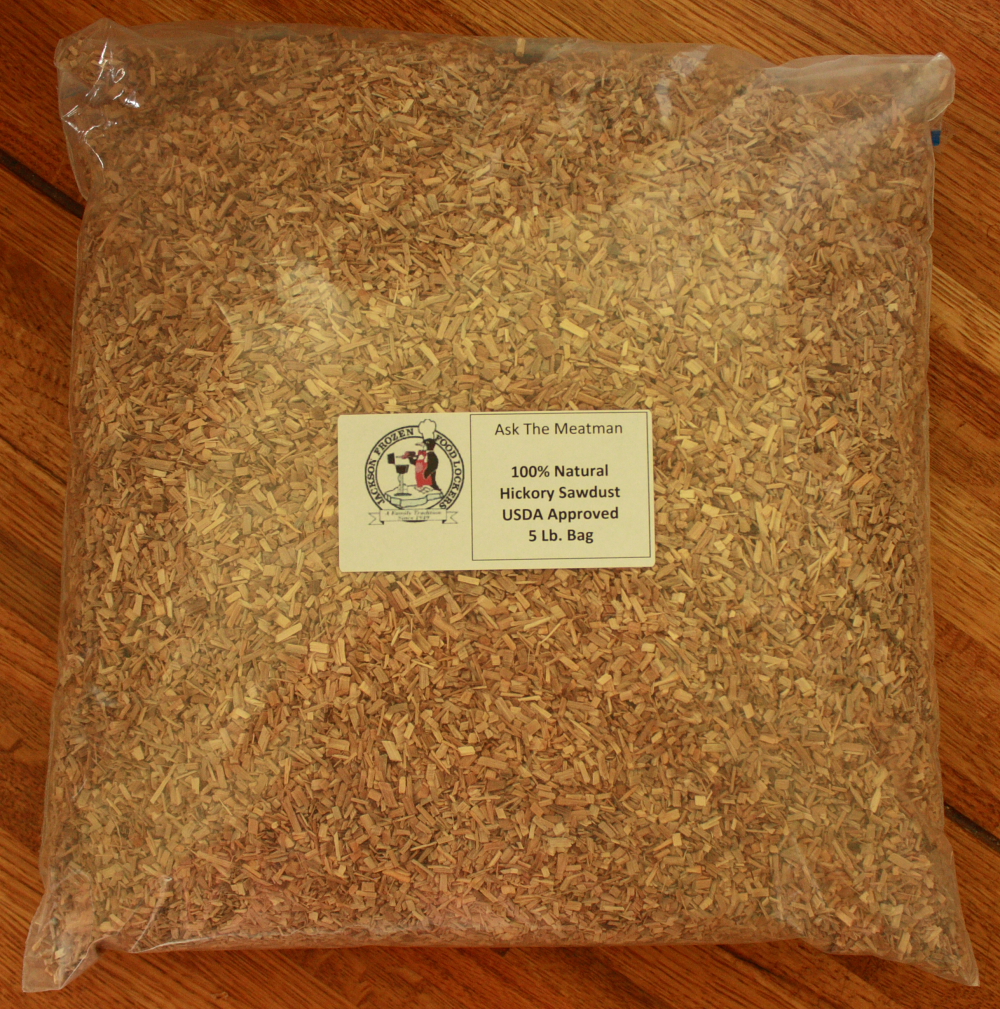
We sell Hickory Sawdust
in 5 lb. bags WAS $29.99 - Now ONLY $24.97! Shipped FREE in the U.S.!
This is the same hickory sawdust that we use in all of our smoking of deer sausage, deer snack sticks, beef jerky, deer jerky, pork hams, pork bacon, pork shoulders and pork jowls.
Here's some short tips about some of the woods used to smoke meat.
1. Alder's natural sweetness is especially suited with pork.
2. Apple's natural sweetness is good for any type of meat. It's great in combination with other woods.
3. Cherry is especially good with beef and pork. It has a tendency to turn meat a rich mahogany color. It's best to balance Cherry wood with Hickory, Alder, Oak or Pecan.
5. Maple is quite similar to Alder wood. Maple is sweet and also darkens the color of meat. Balance it with Alder, Apple or Oak. Sugar Maple wood is the sweetest.
6. Some say to use only Honey Mesquite wood. The Wesatch variety of Mesquite "pops" embers. Mesquite is oily in nature, so it burns hot and fast.
7. Oak. Red Oak is the best variety for smoking.
8. Pear, Peach and Plum. These woods require a certain level of expertise in their use. Peach and Plum woods tend to lose their flavor shortly after being cut. For the best results, make sure you the fruit bearing kind of Plum.
9. Pecan is a member of the hickory family, and becoming more popular for smoking. This is a pungent wood, which should be used sparingly.
10. Dogwood is quite similar to Oak in its smoke flavor.
11. Grapevine cuttings add a nice flavor to fish, poultry and beef. You could achieve the same effect by soaking wood chips in an inexpensive wine before throwing the wood on the coals.
12. Herb woods, such as Basil, Thyme and Rosemary are usually used in combination with other woods. A good combination would be Alder with Basil, and Maple with Rosemary
The Quick and Easy Art of Smoking Food I would recommend this book to any beginner wanting to carry on the art of smoking food. You can find a large selection of grills, smokers and bar-b-q utensils at Amazon's Grills, Smokers & Fryers section.
Looking for some GREAT BBQ Seasoning to go along with your Smoked BBQ? We have the following BBQ Seasonings in stock!
NEW - WE'VE LOWERED PRICES ON PRIME STEAK & BEEFBURGER! Our best selling and most popular Shake-On Seasoning! Prime Steak and Beefburger Seasoning is GREAT On: Filet Mignon, London Broil, Brisket & Hamburger.
1 Jar of Spicecraft Prime Steak and Beefburger Seasoning WAS $14.97 - NOW ONLY $11.97! And AS ALWAYS - Shipped FREE in the U.S.!
Order 1 Jar of Spicecraft Prime Steak and Beefburger Seasoning for only $11.97 - Shipped FREE by USPS Mail! Just Click on the "Add To Cart" Button below
Some other basic smoking tips:
1. Use only hardwood, fruitwood or herb woods for smoking. Avoid softwoods, such as Cedar, Douglas Fir, Pine and Spruce, which are loaded with unpleasant pitch and resin and will ruin your meat.
2. Whenever possible use fresh wood - cut within twelve months of use in order to obtain the most flavorful smoke possible.
3. To obtain the best results, soak wood chips or chunks in HOT water. The heat opens up the wood fibers, allowing the water to more fully penetrate the wood so it smolders, rather than burns.
4. Develop your own blends. Experiment using the various hardwoods, fruitwoods and herb woods available. Think of different combinations as having your own spice cabinet right at your grill.
5. For a unique flavoring, try soaking Oak or Alder chips or chunks in white or red wines. This is an especially effective way to add additional flavor to fish or poultry.
6. Keep a logbook of what you do. Write down what kinds of woods you use and with what kinds of meat. How many spoonfuls of chips, logs or chunks you used. This way, when you have an especially good result, you can easily duplicate the process the next time. Likewise, if you have a failure, you can study what you did and avoid making the same mistake twice.
7. DON'T lift the lid off the cooking unit to see how the meat is cooking. Heat is lost and you lengthen the time it will take your meat to cook. You also lose valuable smoke.
What types of wood to use with various types of meats:
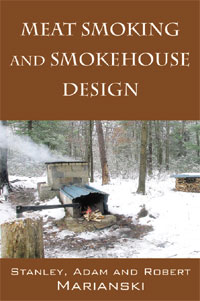
Most books on the subject of smoking include a drawing or two, a few pages on generating smoke, and the rest of the pages are filled with recipes. While those recipes usually get the spotlight, the technical know-how behind preparing and smoking meats is far more important. When writing about cold or hot smoke the authors don't end on just giving the temperature range for a particular method. They also explain why one way is better for making certain products than the other. The second part of the book "The Smokehouse Design" contains all that is known about smoker design and is supported with over 100 drawings and 50 photographs. Many of them are detailed technical drawings with all dimensions for building fully functional units. Some of them can almost be made without any costs involved and when ready will allow for making products of the highest quality.
[Excerpt from book below]
Smoking, barbecuing, and grilling.
A lot of people don't understand the difference between smoking, barbecuing, and grilling. When grilling, you quickly seal in the juices from the piece you are cooking. Grilling takes minutes. Smoking takes hours, sometimes even days.
Don't be fooled by the common misconception that by throwing some wet wood chips over hot coals you can smoke your meat. At best you can only add some flavor on the outside because the moment the outside surface of the meat becomes dry and cooked, a significant barrier exists that prevents smoke penetration.
A properly smoked piece of meat has to be thoroughly smoked, on the outside and everywhere inside. Only prolonged cold smoking will achieve that result. Smoking when grilling is no better than pumping liquid smoke into it and claiming that the product is smoked now.
Let's unravel some of the mystery. All these methods are different from each other, especially smoking and grilling. The main factor separating them is temperature
Smoking - no heat, 52F, 1 hr to 2 weeks
Barbecuing - heat, 200 F, few hours
Grilling - heat, 500F, minutes
The purpose of grilling is to char the surface of meat and seal in the juices by creating a smoky caramelized crust. By the same token a barrier is erected that prevents smoke from flowing inside. The meat may have a somewhat smoky flavor on the outside but it was never smoked internally.
Barbecuing comes much closer, but not close enough. It is a long, slow, indirect, low-heat method that uses charcoal or wood pieces to smoke-cook the meat. The best definition is that barbecuing is cooking with smoke. It is ideally suited for large pieces of meat, like whole pigs. The temperature range of 200? ? F is still too high to smoke meats since the fat that binds meat in sausages will melt away through the casings, and the final product will taste like bread crumbs.
Smoking is what it says: smoking meats with smoke that may or may not be followed by cooking. Some products are only smoked at low temperatures and never cooked, yet are safe to eat. Generally we may say that smoking in most cases consists of two steps:
Smoking Cooking
After smoking is done we increase the temperature to about 170?F (76? C) to start cooking. We want to cook meats or sausages to 152 F? (67? C) internal temperature and here the quality and insulation of the smoker plays an important role. Nevertheless the main smoking process is performed below 140? F.
There are important differences between smoking and barbecuing. Barbecued or grilled meats are eaten immediately the moment they are done. Smoked meats are usually eaten at a later date. When smoking foods a higher degree of smoke penetration is needed and that can only be achieved at lower temperatures. Furthermore, smoked meats are eaten cold. Many great recipes require that smoked products hang for a designated time to lose more weight to become drier. It is only then that they are ready for consumption.
This book is offered from Ask The Meatman.com
You can order this book soon for ONLY $21.97 - Shipped FREE in the U.S.!
It is 308 page long, 9 inch by 6 inch Paperback Book.
Place your order for the "Meat Smoking and Smokehouse Design" Book for ONLY $21.97 by Clicking the "Add To Cart" Button Below! Shipped FREE! This book will be shipped by USPS Media Mail. Average shipping time in the U.S. is 4 to 7 days.